
Last reviewed: November 2026. For official rules, see the Road Safety Authority (RSA), and for the Dublin M50 toll, eflow.ie.
Yes, driving in Ireland is safe for most visitors, including those who’ve never driven on the left. The motorways are good, drivers are generally patient, and signage is clear. The hard parts are narrow country roads, roundabouts in the “wrong” direction, and the first hour behind the wheel. Here’s what to expect and how to make that first day easier.
The key rules at a glance
- Drive on the left, overtake on the right.
- Roundabouts: go clockwise and give way to traffic coming from your right.
- Speed limits in the Republic are in km/h: 50 in towns, 60 on rural local roads (lowered from 80 in February 2025), 80 on regional roads, 100 on national roads and 120 on motorways, unless signs say otherwise.
- Northern Ireland uses mph. Your speedometer may show both, but road signs change at the border.
- Drink driving limit: 50 mg per 100 ml of blood for most drivers, and 20 mg for learner, novice and professional drivers. The safe choice is not to drink at all if you’re driving.
- Emergency numbers: 112 or 999.
Getting used to driving on the left
The first hour is the hardest. Most people manage fine once they’ve done a few junctions.
- Pick up the car somewhere quiet if you can. Collecting at Dublin Airport and heading straight into city traffic is the hardest start.
- Rent an automatic if you normally drive one. Changing gear with your left hand adds a lot to think about.
- Keep your body toward the center line. As the driver, you sit nearest the middle of the road. New drivers tend to drift toward the left edge.
- Say “left, left, left” when you turn out of a junction or car park. It sounds silly and works.
Country roads, the real challenge
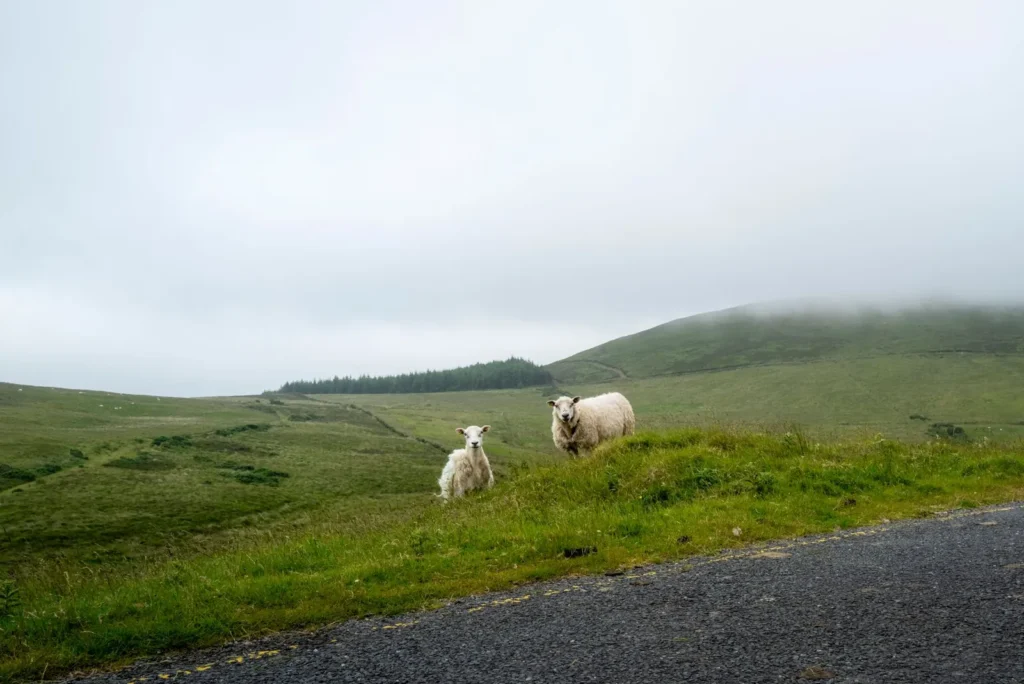
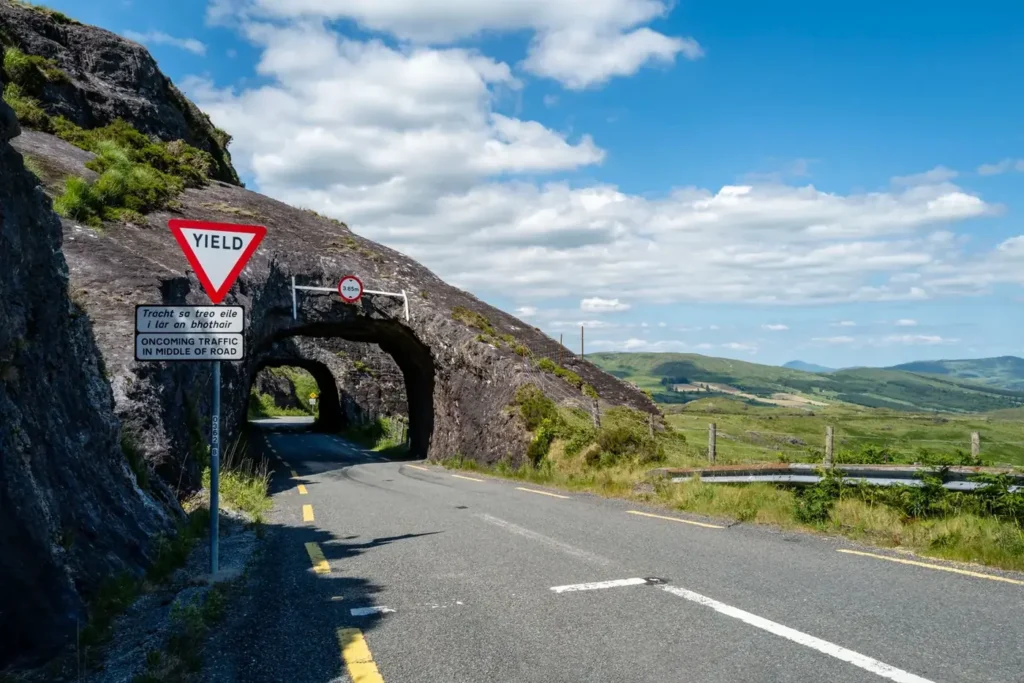
Rural local roads can be a single lane with hedges on both sides, blind bends and tractors. The new 60 km/h default is a limit, not a target.
- Slow down before every bend and be ready to stop.
- Pull into a gap or gateway to let oncoming traffic pass. A wave is the usual thank you.
- Watch for cyclists, walkers and sheep, especially in the west. Single-lane etiquette here is much the same as on Scotland’s North Coast 500, one of the routes in my road trip itineraries from travel bloggers.
- On the Wild Atlantic Way, expect tour coaches on narrow coastal stretches in summer.
Renting a car in Ireland
- Age: many companies prefer drivers aged 25 and over, and add a young driver fee below that. Some have upper age limits or extra checks for older drivers.
- Insurance: collision damage cover is a big part of the price. Some rental firms in Ireland don’t accept credit card insurance in place of their own, so read the terms before you book.
- Size: a smaller car is much easier on narrow roads and in old towns.
- Licence: licences from the US, Canada, the UK and the EU are generally accepted for visitors. Check with your rental company, and see my international driving permit guide.
Tolls and parking
Most tolls in Ireland are paid at a booth. The exception is the M50 around Dublin, which has no barriers. Pay online at eflow.ie by 8 p.m. the day after you drive it, unless your rental company handles tolls for you (ask at the desk). In towns, look for pay-and-display machines or parking apps, and don’t park on double yellow lines.
If something goes wrong
If you break down on a motorway, get everyone out of the car and behind the barrier, then call your rental company’s assistance number. After an accident, call 112 or 999 if anyone is hurt, exchange details, and take photos of the scene and the cars. If documents, cards or your phone go missing on the trip, my step-by-step travel emergency guide covers what to do first.
Frequently asked questions
Is it hard to drive on the left in Ireland as an American?
Most people adjust within a day. An automatic car, a quiet starting point and a small car make it much easier.
Can I use my US licence in Ireland?
Visitors with a valid US licence can generally drive in Ireland. Your rental company may have its own rules, so check before you book.
Are speed cameras common?
Yes. Ireland uses fixed and mobile speed cameras, and fines apply to rental cars too, usually with an admin fee from the rental company.
What’s the hardest road to drive?
Narrow rural roads in counties like Kerry, Clare and Donegal are the most challenging. Take them slowly and enjoy the views at the pull-ins.