


Getting a glimpse of the world beyond our borders is one of the best things you can do for your soul, but let’s be real: being a tourist often feels like having a giant neon sign over your head that says “I have cash and no idea what I’m doing.” Most people you meet on your travels are genuinely kind, but there is always a small percentage of hustlers who have turned parting travelers from their money into a high art form.
As we move through 2026, the old school tricks are still around, but they have been joined by some high-tech updates. The key to not getting taken for a ride… literally or figuratively… is to understand the psychology these scammers use. They rely on your politeness, your desire to be a “good guest,” and your momentary confusion in a new environment. Here is a breakdown of the most common scams currently making the rounds globally and how you can spot them before they cost you a dime.
The “Broken” Taxi Meter and the Scenic Route
This is probably the most universal travel scam in existence. You hop into a cab at the airport or a train station, and the driver informs you with a shrug that the meter is broken. They then quote you a “special price” that sounds reasonable because you haven’t quite mastered the local currency conversion yet. Spoiler: it is never a deal. By the time you reach your hotel, you have paid four times the actual fare.
In some cities, the driver will use the meter but take a route so long it qualifies as a city tour. To avoid this, never get into a taxi without a functioning meter. If they say it is broken, get out and find another car. Better yet, use reputable rideshare apps like Uber, Grab, or Bolt where the price is locked in before you even open the door. If you must use a local cab, have your own GPS running on your phone so you can see if they are taking you in circles.
The “Friendship” Bracelet and the Forced Gift
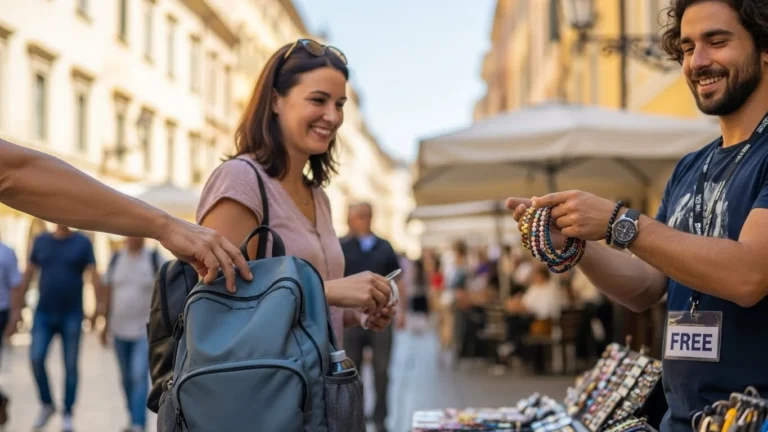
Common in Paris, Rome, and throughout major plazas in Europe, this scam preys on your personal space. Someone will approach you with a big smile and try to tie a “free” braided bracelet around your wrist or hand you a “gift” like a rose or a sprig of rosemary. They might even act like they are just being friendly or asking for the time.
The moment that string is knotted around your wrist, the vibe changes. They will demand payment, often becoming loud or aggressive to embarrass you into paying just to make them go away. The best defense is a strong, loud “No” while keeping your hands in your pockets. If they manage to get something on you, don’t feel obligated to pay. It was a gift you didn’t ask for; walk away and don’t look back.
The “Closed Attraction” Misdirection
This one is a classic in Southeast Asia, particularly around the Grand Palace in Bangkok. A friendly, well-dressed local, or sometimes even someone pretending to be an official, will approach you near a major landmark and tell you it is closed for a holiday, lunch, or a private ceremony. They will then helpfully suggest an alternative temple or a “government sponsored” jewelry sale.
This is always a setup to get you into a tuk-tuk that will take you to shops where they get a massive commission for anything you buy. Always check the front gate yourself. If an attraction is actually closed, there will be official signage. Ignore anyone on the street who tries to redirect your itinerary; they are not being helpful, they are hunting for a kickback.
A Moment of Temporary Insanity
I once fell for a version of the “tea ceremony” scam in Shanghai, and I still kick myself for it. Two “students” approached me asking to practice their English and invited me to a traditional tea house nearby. I wanted to be the culturally sensitive traveler, so I went. Three tiny cups of tea later, I was handed a bill for nearly $200. I felt that immediate sinking feeling in my stomach where you realize your own politeness has been weaponized against you. I ended up paying about half after a heated argument, but the real cost was the afternoon of looking over my shoulder at every friendly face. It taught me that while it is great to be open to new people, a truly “local” experience rarely starts with a stranger approaching you in a high-traffic tourist zone.
The “Fake Police” and Document Check
This is a more intimidating scam that pops up in cities like Barcelona or Prague. A plainclothes “officer” will approach you, flash a badge that looks official enough in the dark, and claim they are checking for counterfeit bills or drug activity. They will ask to see your passport and your wallet.
While you are showing them your cash to prove it isn’t “counterfeit,” they use sleight of hand to lift several bills, or they simply walk away with your entire wallet while you are distracted by their partner. Legitimate police will almost never ask to see your wallet on the street. If someone approaches you like this, insist on going to the nearest police station to show your documents. Most scammers will vanish the moment you suggest involving actual uniformed authorities.
The QR Code “Quishing” Trap
This is a new one for 2026. As restaurants and parking meters have moved toward QR code payments, scammers have started placing fake stickers over the legitimate ones. When you scan the code to pay for your meal or your parking spot, you are directed to a phishing site that looks identical to the real one but is designed to harvest your credit card data.
Before you scan, check if the QR code is a sticker placed over the original. If it feels loose or looks slightly off-center, don’t use it. Whenever possible, pay through an official app or ask the staff for a physical bill. If you do scan a code, look closely at the URL in your browser before you enter any payment details. If the website name looks like a jumble of random letters, close the tab immediately.
The “Spill on Your Clothes” Distraction
This is a team effort. Someone will “accidentally” spill mustard, ketchup, or even fake bird droppings on your shoulder. They will apologize profusely and start dabbing at the mess with a tissue, acting completely mortified. While you are looking at your shirt and they are “helping” you, their partner is busy emptying your pockets or sliding your bag off your shoulder.
If anyone spills anything on you, immediately secure your bags and walk away. Do not let them touch you or your clothes. Clean it up yourself in a bathroom or your hotel room. Any sudden, weird commotion, like a fake fight, someone falling, or a spill, is almost always a tactical distraction designed to make you forget about your belongings for ten seconds.
